Start with your goal
“Get better” can mean many things: feeling calmer, linking turns, enjoying a run with family or preparing for instructor training. Define a goal you can recognise in your skiing.
MY APPROACH / THE ADULT LEARNER’S VIEW
My approach starts with the person learning. What are you trying to achieve, what is getting in the way, and what would make the next step understandable?
I started skiing later in life. The experience of learning is recent enough that I can remember the uncertainty as well as the breakthroughs. Progressing to IASI Level 2 gave me a structured way to develop my understanding and think about how learning happens.
I don’t see those as competing identities. Remembering the beginner helps me stay patient with the question; instructor training helps me look more closely at the answer. Continuing my own training keeps me open to changing it.
THE PRINCIPLES I VALUE
“Get better” can mean many things: feeling calmer, linking turns, enjoying a run with family or preparing for instructor training. Define a goal you can recognise in your skiing.
Instructions make more sense when you know what they are intended to change. Ask what you should notice and how the task connects to the skiing you want.
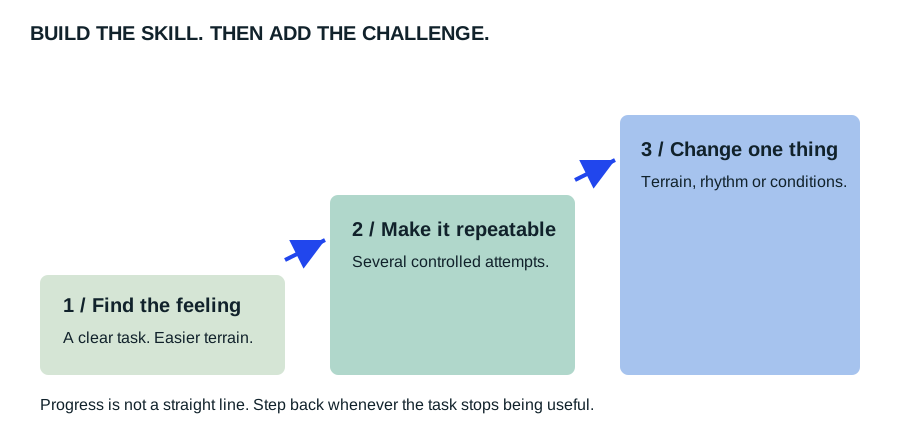
A head full of instructions is difficult to ski with. Choose one useful cue for a short practice block, then review it before adding another.
Difficulty should serve the learning. Easier terrain can free up attention for a new movement; adding steepness too early can bring old habits straight back.
Combine what you felt with what happened. A short video can help answer a specific question; one freeze-frame does not explain an entire turn or a whole skier.
A change that you can repeat with less effort is valuable. So is noticing earlier when something starts to go wrong. Progress is bigger than the colour of the piste.
CONFIDENCE / CONTROL / CURIOSITY
As an adult learner, I understand how much thinking can happen before a turn. Confidence is easier to build when the task feels achievable and you understand your options.
I value a calm reset: make the goal smaller, choose a setting where you can explore it, and identify what worked. “Just be more confident” does not tell a skier what to do next.
There will be days when snow, visibility, fatigue or nerves change the plan. Recognising that and adapting is part of learning to ski well.
A PRACTICE BLOCK TO DISCUSS WITH YOUR INSTRUCTOR
THE CONVERSATION CONTINUES
My CarveCast conversation with Level 4 instructor Scott Hammond explores teaching, understanding and development beyond a list of technical instructions.
A conversation with Scott Hammond about ski education and helping individuals develop. The ideas are part of a wider discussion, alongside my own perspective.
Episode 16: watch, listen & read more ↗TRAIN WITH SIMON / SKI WITH ME
If you’re looking for lessons, coaching or help taking your skiing further, get in touch with Simon at PDS Snowsport. Tell him about your skiing level, your goals and when you’d like to train.
If you’d like to ski with me, get in touch directly. Tell me where and when you’re planning to ski, your level and what you have in mind, and we can talk about the possibilities.