Before the run
Agree the task, the terrain and where to stop. Know what you are looking for and keep the goal realistic for the conditions.
SKILLS EXPLAINED / A VISUAL STARTING POINT
A plain-language guide to the questions that come up as skiing develops. Use these ideas to frame a useful conversation with your instructor and give your next training day a focus.
Diagrams are simplified teaching illustrations. Terrain, other slope users and the conditions always matter; choose on-snow exercises with an instructor who can see your skiing.
01 / BALANCE IS ACTIVE
Balance is something you keep adjusting as the skis travel over snow and through a turn. Thinking about a single fixed pose can make it harder to respond naturally.
The ankles, knees and hips all contribute to movement. The useful question is whether you can adapt and stay connected to what the skis are doing, rather than hold a position that only looks right in a photograph.
“Where do I feel pressure through my feet, and does that change when the task or terrain changes?” Explore it on a manageable slope with your instructor.
02 / TURN SHAPE & SPEED
A turn changes your direction of travel. A more direct line and a rounder line take you through the slope differently. Learning to shape a turn gives you options for managing your descent.
Rounder turns can spend more time travelling across the hill. Actual speed also depends on the gradient, snow, grip, skidding and how the skier moves. The diagram compares shapes, not a guaranteed speed result.
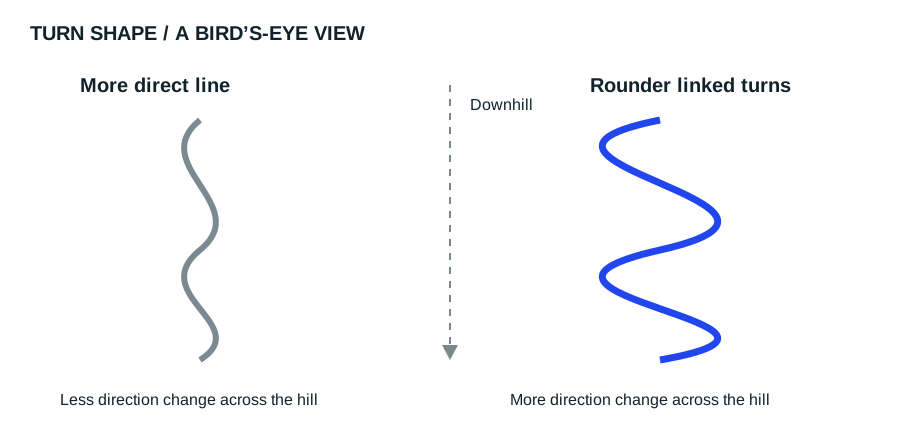
Useful question: “Am I choosing my line before I start the turn, or reacting after I have already picked up speed?” Look ahead and leave room for other people on the slope.
03 / STEERING & EDGE CONTROL
Skidding is a useful part of skiing. The skis can move sideways as well as forwards, helping the skier adjust direction and manage speed. A controlled skidded turn is a skill worth developing.
In a carved arc, the ski’s edge and shape guide it through the snow with little sideways slip. Carving is one tool; it is not the right answer to every slope, speed or snow condition.
Steering the skis and controlling the edges work together with balance and pressure. Ask your instructor which part needs attention in your skiing instead of chasing a bigger edge angle for its own sake.
Use a quiet, appropriate area and a task chosen for your ability. The goal is a useful response from the skis that you can control and repeat.
Watch the training conversations ↗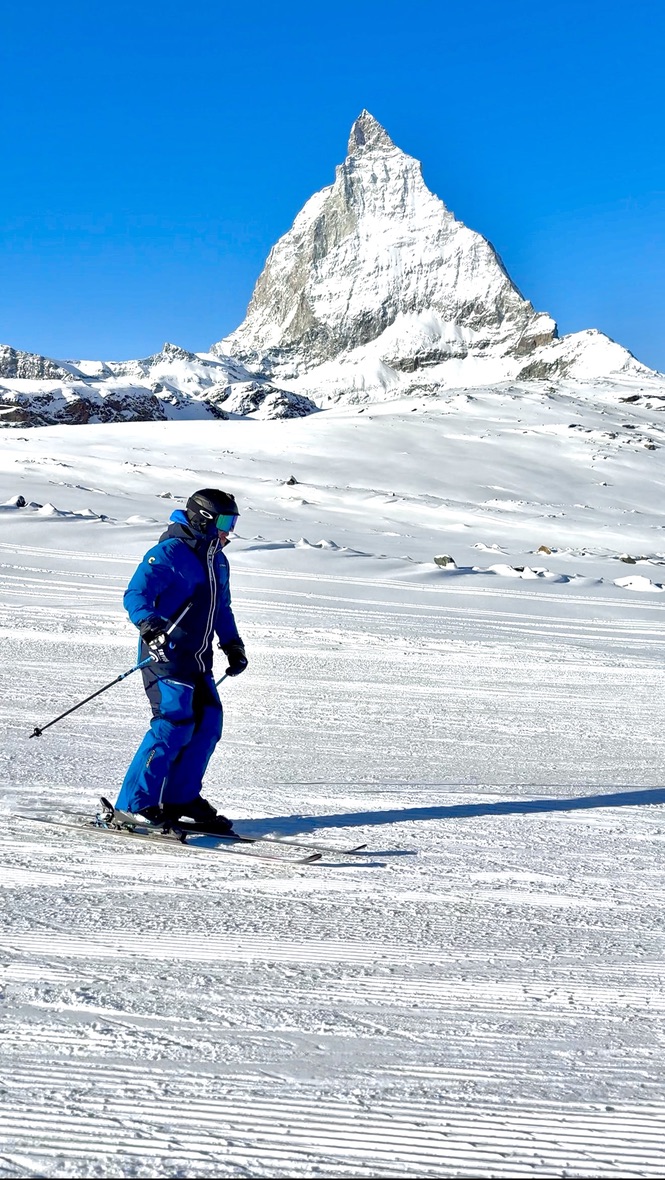
04 / RHYTHM & CONSISTENCY
Rhythm is the pattern and timing connecting one turn to the next. It helps to think about the whole sequence, including the transition, rather than treating every turn as an isolated event.
Consistent does not mean rigid. Good skiing adapts to space, terrain, conditions and the people around you. Work towards a rhythm you can change deliberately.
Watch a short sequence of your own turns. Do the left and right turns have a similar shape and timing? A difference gives you a question to explore, rather than a reason to judge the whole run.
05 / THE EQUIPMENT CONNECTION
My own boot-fitting journey has involved plenty of trial and error. Fit, support and comfort influence the feedback you get through your feet and how freely you can move.
Persistent pain, poor heel hold or an inability to find a workable position are worth discussing with a qualified boot fitter. More expensive equipment does not replace technique, and a stiffer boot is not automatically the better choice.
I only ski Stöckli. That is my equipment preference; the learning starts with the person and the task.
My personal ski-boot journey and the lessons behind it. For individual fitting advice, speak to a specialist boot fitter.
Episode 22: watch, listen & read more ↗06 / TURN THE IDEA INTO PRACTICE
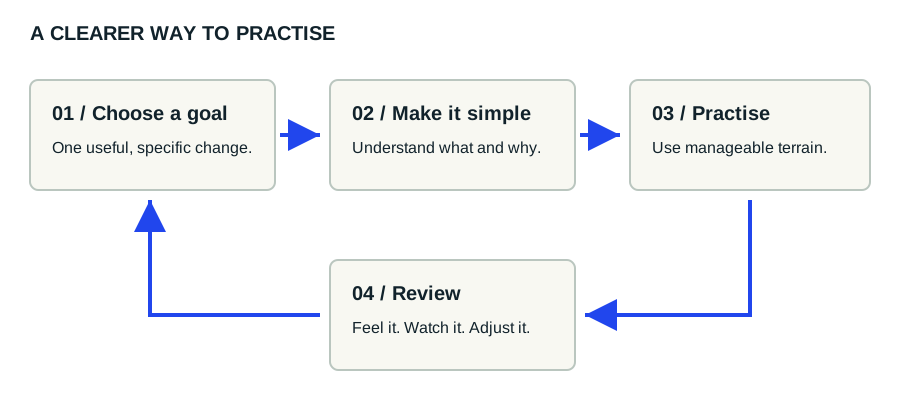
Agree the task, the terrain and where to stop. Know what you are looking for and keep the goal realistic for the conditions.
Keep enough attention available for the slope and other skiers. If the exercise takes over your awareness, simplify it or stop and discuss it.
Describe one thing you noticed. Combine that feeling with your instructor’s feedback and decide whether to repeat or adjust.
TRAIN WITH SIMON / SKI WITH ME
If you’re looking for lessons, coaching or help taking your skiing further, get in touch with Simon at PDS Snowsport. Tell him about your skiing level, your goals and when you’d like to train.
If you’d like to ski with me, get in touch directly. Tell me where and when you’re planning to ski, your level and what you have in mind, and we can talk about the possibilities.